Have you always wondered why some companies seem to know their customers like the back of their hand, close deals in record time, and grow their business effortlessly, while other companies struggle to keep pace? The answer to success for many of them lies in Salesforce.
Salesforce is the most prominent cloud-based CRM solution in the world, supported by 150,000+ businesses globally, and 90% of Fortune 500 companies. In 2025, it succeeded in grabbing over 20% of the market share of the CRM market in the world, marking the unparalleled capabilities of the solution in customer data organization, workflow automation, and improvement of team productivity.
As a small business in the UK or as a growing company in the USA, the knowledge of what Salesforce is in the year 2026 may be the game-changer for how you sell, market, and service your customers.
What Is Salesforce?
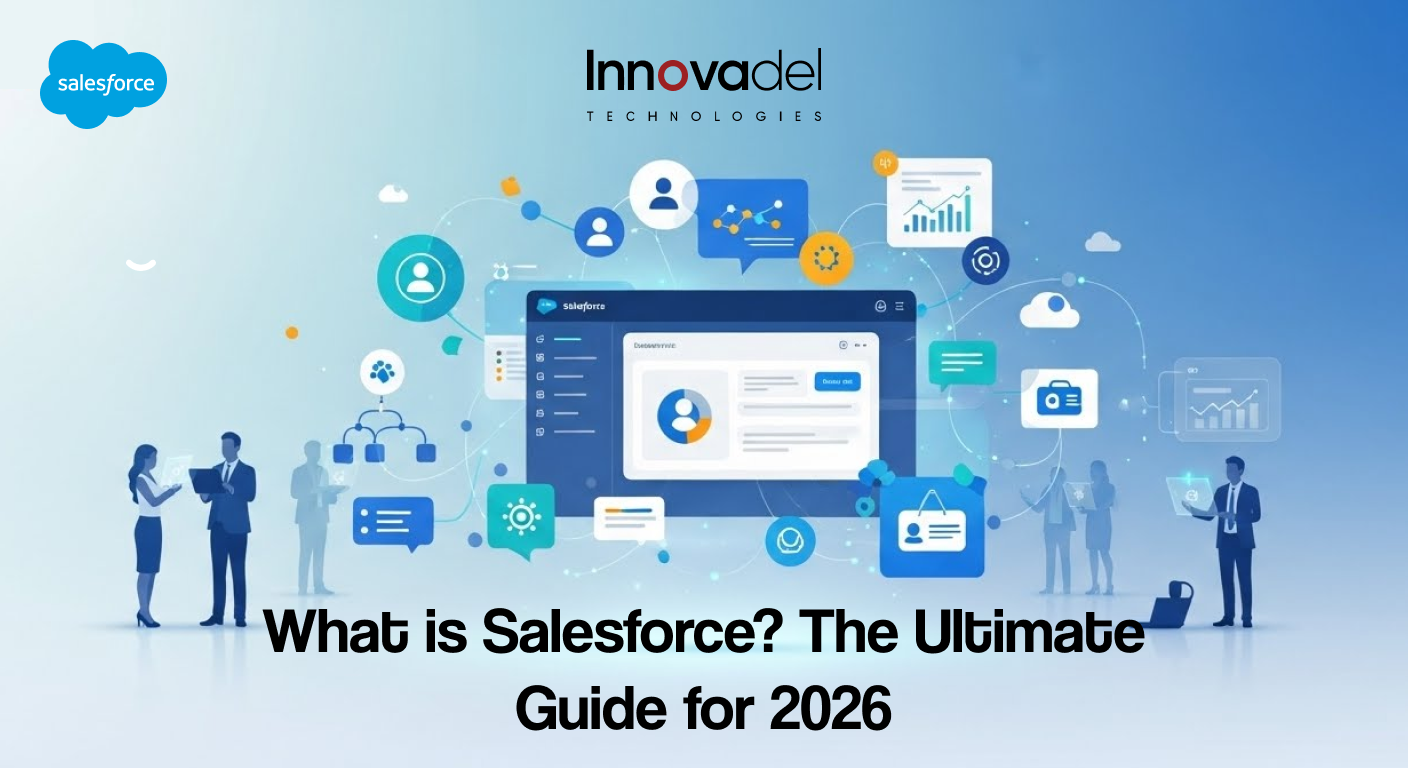
Salesforce is a cloud-based software company that helps businesses find more leads, close deals faster, and deliver better service to customers.
Salesforce is a popular CRM platform utilized by sales, marketing, and customer support teams across the globe. It assists companies in managing customer information, monitoring customer contacts, and enhancing customer and partner communication.
Salesforce can empower an organization to:
- Monitor the activity of customers and the opportunities in sales.
- Run marketing campaigns and do the automation for repetitive tasks.
- Visualize data into dashboards for informed decisions.
- Offer tailored services; this will keep customers satisfied.
In short, Salesforce is more than a CRM tool; it’s a complete platform that helps businesses work smarter, serve customers better, and grow efficiently.
Salesforce & CRM Background
In 1999, Parker Harris, Marc Benioff, Frank Dominguez, and Dave Moellenhoff established Salesforce. They intended to develop an easy-to-use, cheaper, and more accessible cloud-based CRM than the traditional CRM software, which was typically costly and complex.
In 2004, Salesforce was launched publicly on the New York Stock Exchange with the ticker symbol CRM, enhancing its standing as one of the best CRM providers. The company has grown over the years to provide cloud services to sales, marketing automation, analytics, and customer service in addition to the CRM.
In 2005, Salesforce introduced AppExchange, a marketplace where third-party developers had the ability to build and share apps. This contributed to the development of the Salesforce ecosystem and increased its potential.
Salesforce is a leading cloud computing company worldwide today, with a steady progress of strategic acquisitions such as MuleSoft, Tableau, and ExactTarget.
How Does Salesforce Work?
Rather than using spreadsheets, emails, and stand-alone applications, Salesforce puts all customer data into one cloud-based application.
It monitors leads, contacts, accounts, and opportunities thus providing the businesses with a clear picture on all their interactions with customers. It also automates frequent activities, like email, records, and follow-ups, which is time-saving and error-reducing.
Customer support can handle the questions and cases, answer them promptly, and deliver uniform services. Salesforce also possesses reporting and analytics tools that assist businesses in tracking performance, customer behavior, as well and making sound decisions.
Through the integration of all these tools in the cloud platform, Salesforce assists in effectively managing customers, sales, as well as service delivery in an organization.
What Makes Salesforce Stand Out from Other CRMs?
Salesforce CRM is a cloud-based software that assists businesses in managing sales, marketing, and customer service under a single platform.
1. Cloud-Based
Salesforce is cloud-based, and therefore, teams can access customer data at any time and place. This has simplified work in the UK, USA, and across the globe as businesses remain connected and work effectively.
2. Easy to Use
The platform is easy and user-friendly, which means teams can follow leads, organize opportunities, and assist customers without extra training.
3. Customizable
Salesforce can be customized to business requirements by adding custom dashboards, workflows, and fields to adapt it to the business’s sales, marketing, and service activities.
4. App Marketplace
The AppExchange allows companies to add applications and solutions to enhance Salesforce capabilities and integrate them with other systems.
5. Analytics
Salesforce offers sales, customer, and marketing performance reports and dashboards to enable businesses to make more effective decisions.
6. Collaboration and Mobile
Information can be easily shared, and teams can work together efficiently. The mobile application will enable access to customer data and tasks in real-time.
7. Security
Salesforce stores customer information in a secure environment with high security level and international compliance.
Who Uses Salesforce?
Salesforce has been ranked as one of the most popular CRM in the world. It is used by millions of people and businesses to do sales, marketing and customer service.
| Type of User | How They Use Salesforce |
| Small & Medium Businesses | Store customer data in a single place, lead tracking, and sales. |
| Large Companies | Control sales, marketing, and customer service; 90 percent of Fortune 500 companies employ it. |
| Sales Teams | Follow up on deals and close sales at a greater speed. |
| Marketing Teams | Run campaigns, reach the right customers, and track results |
| Customer Support Teams | Handle cases, respond quickly, and help customers better |
| Tech Companies | Manage customers and support business growth |
| Retail & E-commerce | Personalize offers and improve customer experience |
| Healthcare | Track patients, appointments, and services easily |
| Financial Services | Manage clients, automate tasks, and stay compliant |
| UK & USA Businesses | Streamline work and grow efficiently |
Salesforce is the most popular choice among large and small businesses as it serves millions of users in more than 100,000 companies worldwide today.
Top Companies Using Salesforce to Drive Business Success
Many big companies use Salesforce to manage their sales, marketing, and customers. Here’s how some of them do it:
- Amazon – Keeps customers happy by handling their service requests quickly.
- Spotify – Sends personalized music suggestions and offers to users.
- Toyota – Tracks customers and sales to give a better experience.
- Walmart – Makes online and in-store shopping smooth and connected.
- American Express – Manages customer relationships easily.
- Coca‑Cola – Handles sales and customer service efficiently.
- L’Oréal – Keeps customer info organized and runs campaigns.
- IBM – Stays in touch with customers and improves teamwork.
- BMW – Tracks sales and customer information for a better experience.
- Canon – Keeps an eye on customers and sales pipelines.
Salesforce is used by thousands of companies around the world. It helps them stay organized, take care of their customers, and grow their business.
Why Use Salesforce?
Salesforce assists companies in managing their sales, sales, and customer management in a single platform. It minimizes human effort and enables the team to become more efficient and offer superior customer experiences.
- Greater sales control: Companies are able to monitor leads, prospects, and customer meetings in a single space.
- Time-saving automation: Salesforce automates the mundane company activities including follow-ups, emails, and workflow updates.
- Better customer service: Support teams can see the full history of their customer with tools such as Agentforce 360, and it can assist them in solving the problems with better speed and accuracy.
- Single database of customers: Customer data is stored safely and it is also accessible by teams.
- Easy business understanding: Reports and dashboards offer transparency of sales performance, customer behavior and service trends.
- Scalability: Salesforce can be expanded as the business expands, small team to large business.
- Integrations: The platform is well integrated with email, marketing, and other business systems.
- Ease of access: Salesforce can be accessed and used by teams both at their desktops or cell phones.
Due to these advantages, the companies in the UK and USA use Salesforce to enhance their productivity, improve their relationship with the customers, and ensure the growth in the long term.
Salesforce Architecture
To get a sense of how Salesforce functions, one should know how the platform is organized. Salesforce architecture is created in such a way that it supports numerous businesses simultaneously and keeps the data safe and simple to handle.
Superpod
A Superpod is a group of systems that work together to run Salesforce smoothly. Each Superpod serves thousands of customers and includes tools like servers, storage, and load balancers that keep the platform fast and reliable.
Org (Organization)
An org is created every time a business signs up for Salesforce. It is a private space where companies manage their data, users, and settings. Businesses can customize their org by creating workflows, setting permissions, and adjusting the interface.
App
An app in Salesforce helps users organize their work. It groups related items like pages and objects in one place, making Salesforce easier to use and navigate.
Instance
An instance is the Salesforce environment a user logs into. It shows which server is hosting their org. Multiple instances can run on the same server, and users may connect from different regions.
Sandbox
A sandbox is a safe testing space that copies your main Salesforce setup. Businesses use sandboxes to test changes, build features, or train users without affecting live data. Salesforce offers different sandbox types based on testing needs.
What Is Salesforce Infrastructure?
Salesforce infrastructure refers to the infrastructure that powers the daily operations of the Salesforce environment. It consists of servers, data centers, and security solutions that enable companies to utilize the services provided by Salesforce through the online platform.
Salesforce operates on a global cloud network, making it easy for people to access the system from anywhere in the world. These are some benefits of using Salesforce within an organization.
Security is a crucial component of Salesforce’s infrastructure. Customer information is safeguarded by effective security systems, ensuring that only authorized individuals can access the information.
The infrastructure is designed to expand along with businesses. When a business increases their number of users and data, Salesforce’s system automatically adjusts to ensure smoother operations and is not slowed down. Backup systems also ensure the safety of business data and prevent downtimes.
Salesforce Products and Services for Businesses
Salesforce has a variety of cloud-based CRM solutions which assist companies in managing sales, marketing, customer service, eCommerce, and analytics within one platform. The following is a basic list of the key Salesforce products:
- Sales Cloud: Assists sales teams in tracking down leads and deals. The sales process is visible to the teams, and the process takes a shorter time to close deals.
- Service Cloud: It simplifies customer support. Questions and requests can be addressed by teams using email, chat, or telephone, and this provides a quicker and more efficient service.
- Marketing Cloud: Marketers can use this feature to stay in contact with their customers by creating campaigns, sending messages, and emails, to help boost sales.
- Commerce Cloud: Assists companies in carrying out online shops and provides their customers with an experience of shopping online or on mobile. Works for both B2B and B2C.
- Experience Cloud: Let’s businesses develop customer, partner, or employee portals. Enhances self-service, teamwork, and communication.
- Data Cloud / Customer 360: Gathers all the information about customers in a single location. Helps businesses know the customers better and give them a more personal service.
- Analytics Cloud / Tableau: Helps simplify the process of monitoring performance, quantifying the outcome, and learning customer trends.
- MuleSoft / Integration Cloud: The integration software relates Salesforce to other applications and systems to ensure that information flows freely.
- Einstein: Gives recommendations and ideas on how teams can make their decisions better.
- Other Services: Salesforce also assists businesses to establish, personalize, and receive support such that they can make the most out of it.
Top 7 Benefits of Salesforce for Businesses
Salesforce CRM helps businesses save time, improve customer relationships, and grow faster. Here are the top benefits:
1. Save Time
All your customer info is in one place, so you don’t waste time searching. You can plan your work, calls, and meetings easily.
2. Access Anywhere
Salesforce is online, so you can use it on your computer, laptop, or phone. Check files and stay updated from anywhere.
3. Make More Money
Salesforce handles routine tasks like updating records and organizing data. This frees up time to focus on customers and grow your business.
4. Happier Customers
You can quickly see customer info, purchase history, and preferences. This helps you provide better service and keep customers happy. Happy customers may also tell others about your business.
5. Easy Account Planning
All customer info is ready in one place, so you can organize your work and give customers what they need. This keeps you organized and builds stronger relationships.
6. Clear Reports
Salesforce turns all your data into simple reports. You can track trends, measure results, and make decisions easily.
7. Better Teamwork
Teams can talk and share information easily using the “Chatter” feature. Everyone stays on the same page, no matter where they are.
Salesforce vs Other CRMs
Choosing the right CRM can make a big difference for your business. Salesforce stands out when compared to other popular CRM platforms. Here’s how:
| Feature / Aspect | Salesforce | Other CRMs |
| Deployment | Cloud-based (SaaS) | Cloud-based or on-premise, depending on CRM |
| Customization | Highly customizable with apps, workflows, and code | Limited customization in basic plans; advanced in enterprise |
| Integration | Extensive integrations with 3rd-party apps & APIs | Varies by CRM; may need extra plugins |
| Pricing | Higher starting cost, flexible enterprise pricing | Usually cheaper, often tier-based |
| Ease of Use | Steeper learning curve, especially for admins | Generally more user-friendly |
| Automation | Advanced automation and AI tools (Einstein AI) | Basic to moderate automation |
| Analytics & Reporting | Powerful reporting dashboards, AI insights | Reporting available, but less advanced |
| Scalability | Highly scalable for large enterprises | Good for small to medium businesses |
| Mobile Access | Fully-featured mobile app | Varies; some CRMs have limited mobile functionality |
| Customer Support | 24/7 support, extensive community & resources | Limited support in free/basic plans |
| Industry Focus | Flexible across industries, strong in enterprise | Some CRMs are industry-specific |
How Innovadel Helps Businesses With Salesforce
Innovadel Technologies is a trusted Salesforce partner with years of experience helping businesses in the UK, USA, and worldwide use Salesforce effectively.
Expert Guidance
Our certified Salesforce consultants help you choose the right solutions—Sales Cloud, Service Cloud, Marketing Cloud, Commerce Cloud, Experience Cloud, and Data Cloud—based on your business needs.
Easy Setup & Customization
We set up Salesforce to match your workflows. Dashboards, automation, and custom features make Salesforce work exactly for your business.
Smooth Integrations
Innovadel connects Salesforce with your existing tools like ERP systems, eCommerce platforms, and other apps, ensuring data flows easily and securely.
Data Migration & App Building
We help move data from old systems and build custom apps, making sure everything works without disruption.
Ongoing Support
Our team provides support, updates, and optimization so Salesforce stays efficient and meets your goals.
Team Training
We train your team to use Salesforce confidently, improving adoption, productivity, and ROI.
Real Results
We’ve helped businesses in e-commerce, retail, tech, and finance, including Movado, Life Is Good, MVMT, and PUR Cosmetics, improve operations and customer engagement using Salesforce.
Final Thoughts
Salesforce is one of the most powerful CRM platforms available today. It helps businesses manage sales, marketing, customer service, and customer data in one place. Its flexibility, scalability, and cloud-based approach make it a strong choice for businesses of all sizes.
To get the real value from Salesforce, the right setup and ongoing support are essential. This is where Innovadel makes a difference. With proven Salesforce expertise and hands-on experience, Innovadel helps businesses implement, customize, and optimize Salesforce based on real business needs.
If you’re planning to start with Salesforce or want to improve your current setup, connect with Innovadel to explore how our Salesforce consulting services can help you achieve better results and long-term growth.
FAQs
1. What is Salesforce used for?
Salesforce is used to manage sales, customer service, marketing, and customer data in one platform. Businesses use Salesforce CRM to track leads, close deals faster, support customers efficiently, and build long-term customer relationships using cloud-based tools.
2. Is Salesforce only for large companies?
No, Salesforce is not only for large enterprises. Small businesses, startups, and growing companies also use Salesforce. It offers flexible pricing and scalable features, allowing businesses to start small and expand as their needs and teams grow.
3. Why do companies choose Salesforce over other CRMs?
Companies choose Salesforce because it is highly customizable, cloud-based, and scalable. It supports sales, service, marketing, and analytics in one ecosystem. Salesforce also integrates easily with other tools, making it suitable for businesses of all sizes.
4. Is Salesforce hard to learn for beginners?
Salesforce is beginner-friendly, especially for basic CRM tasks. While advanced features may take time to learn, Salesforce offers a simple interface, training resources, and guided tools. With proper setup and training, teams can start using it quickly.
5. How long does Salesforce implementation take?
Salesforce implementation usually takes a few weeks to a few months. The timeline depends on business size, customization level, integrations, and data migration needs. Simple setups are faster, while complex business workflows require more planning and testing.