Most businesses don’t have a sales problem or a service problem. They have a visibility problem.
Your sales team doesn’t know what the support team is handling. Managers are pulling reports manually every Monday. Leads go cold because nobody followed up in time. And when someone leaves the company, half the customer knowledge walks out with them.
Sound familiar? You’re not alone. This is exactly the problem Salesforce was built to fix, and it’s been fixing it for over 150,000 businesses around the world for 26 years.
Salesforce is not just a CRM. It’s the platform that connects your sales, marketing, service, and data in one place, so every person on your team works from the same page, every single time.
Here are 10 straight-to-the-point reasons why Salesforce could be the best business decision you make this year.

Contents
- 1 Top 10 Reasons Why You Need Salesforce for Your Business
- 1.1 1. World’s #1 CRM Platform
- 1.2 2. All Your Customer Data in One Place
- 1.3 3. Save Hours Every Week With Smart Automation
- 1.4 4. Grows With Your Business — From Startup to Enterprise
- 1.5 5. AI-Powered Insights That Actually Help
- 1.6 6. Built for Your Business — Not the Other Way Around
- 1.7 7. Connects With Every Tool You Already Use
- 1.8 8. Deliver Customer Service That Actually Impresses
- 1.9 9. Enterprise-Grade Security You Can Trust
- 1.10 10. A Global Ecosystem You Can Lean On
- 2 How Salesforce Stacks Up
- 3 The Bottom Line
- 4 FAQs
Top 10 Reasons Why You Need Salesforce for Your Business
1. World’s #1 CRM Platform
Salesforce has been named the #1 CRM provider by IDC for 12 consecutive years. It holds over 20.7% of the global CRM market, more than its four closest competitors combined. When the world’s most trusted companies choose a platform, that’s not a coincidence. That’s proof. Salesforce beats SAP, Oracle, Microsoft, and Adobe in CRM market share, combined.
2. All Your Customer Data in One Place
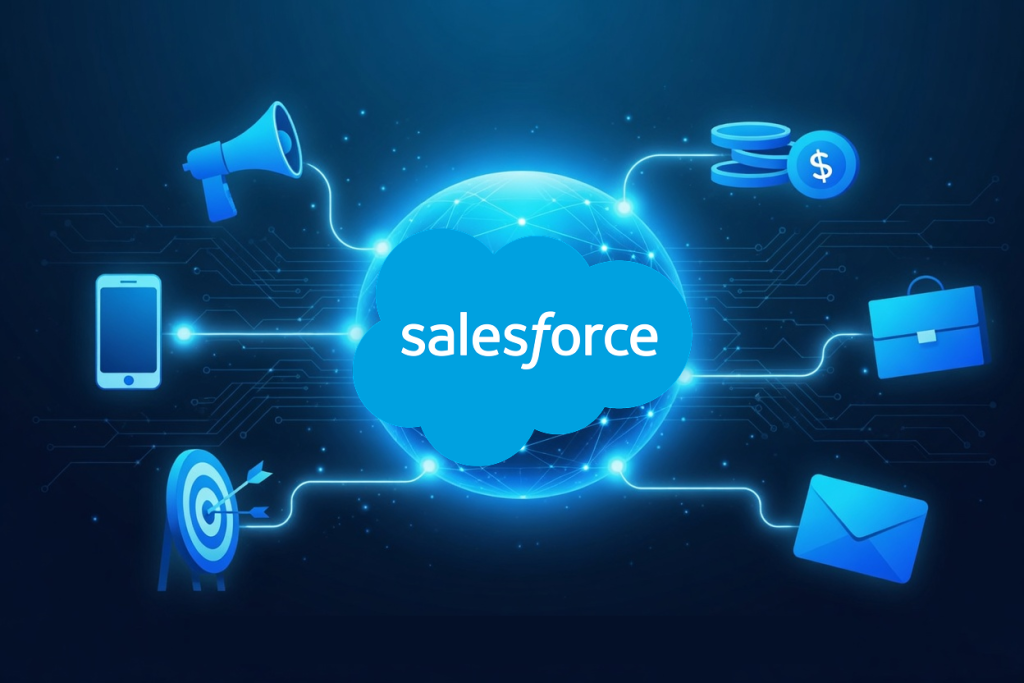
Salesforce is not just a contact book. It’s a complete business platform that brings together your sales, marketing, customer service, analytics, and operations, all under one roof. No more switching between ten different tools or losing data in a spreadsheet somewhere.
The core products include Sales Cloud for managing leads and deals, Service Cloud for customer support, Marketing Cloud for campaigns, and Commerce Cloud for e-commerce. Each one talks to the other, so your team always has a full, clear picture of every customer.
3. Save Hours Every Week With Smart Automation
Repetitive tasks kill productivity. Salesforce lets you automate follow-up emails, lead assignments, approval workflows, and reminders, so your team can focus on what actually moves the needle. Businesses using Salesforce automation report up to 38% faster decision-making and significantly reduced manual effort across sales and service teams.
4. Grows With Your Business — From Startup to Enterprise
Whether you have 5 employees or 5,000, Salesforce scales with you. Start with Sales Cloud for your core pipeline. Add Service Cloud when you need support tools. Layer on Marketing Cloud as your campaigns grow. You’re never stuck. You never have to migrate to a new system because you’ve outgrown the old one. Salesforce grows when you grow.
Salesforce customers report an average 18.4% jump in revenue, a 35% increase in customer satisfaction, and 38% faster decision-making after implementing the platform — according to Salesforce’s own customer success data. Those aren’t marketing claims. That’s what companies actually experience.
5. AI-Powered Insights That Actually Help
Einstein AI delivers billions of predictions and insights every day. It tells you which leads are most likely to convert, which customers are at risk of churning, and what actions your team should take next. This isn’t just data, it’s actionable intelligence built right into your workflow.
6. Built for Your Business — Not the Other Way Around
Every business is different. Salesforce is one of the most customizable platforms available. You can build custom apps, create unique workflows, set up industry-specific pipelines, and connect it with the tools you already use — all without heavy coding. The AppExchange marketplace alone has thousands of ready-made integrations for virtually any business need.
7. Connects With Every Tool You Already Use
Salesforce plays well with others. It integrates with Gmail, Outlook, Slack, WhatsApp, QuickBooks, SAP, and thousands more through its open API. Your marketing, sales, finance, and support teams can all work from connected data without silos or manual data transfers. When your tools talk to each other, your business runs smoother.
8. Deliver Customer Service That Actually Impresses
Salesforce Service Cloud is the #1 customer service platform in the world, for the 12th consecutive year. It helps your support team resolve cases faster, manage omnichannel communication (email, chat, phone, social), and keep customers happy without the chaos. Businesses using Service Cloud see measurably better first-contact resolution and customer retention rates.
Innovadel Technologies helps companies implement and customize Salesforce the right way, from initial setup to advanced automation. Talk to our team today.
9. Enterprise-Grade Security You Can Trust
Data security is not optional. Salesforce is built on a trusted cloud infrastructure with multi-layer encryption, role-based access controls, real-time monitoring, and compliance with GDPR, HIPAA, ISO 27001, and SOC 2. Your customer data stays protected, and your business stays compliant, without you having to build any of that yourself.
10. A Global Ecosystem You Can Lean On
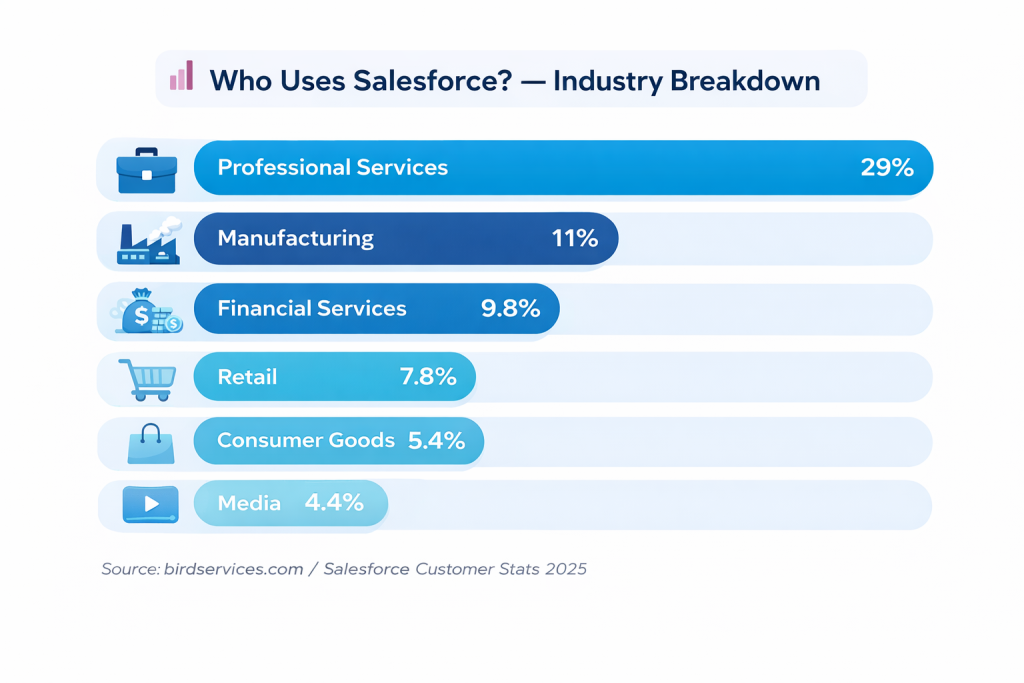
Salesforce has one of the richest ecosystems in enterprise software. Over 83,334 employees, a certified partner network across 100+ countries, the Trailhead learning platform with free courses, and an active community of millions of users and developers. When you choose Salesforce, you’re not just buying software, you’re joining a support system that helps you succeed long-term.
Over 90% of Fortune 500 companies use Salesforce. Globally, Salesforce earned over $21.6 billion in CRM revenues in its latest fiscal year, that’s more than $5 billion greater than its four closest competitors combined. It’s not just the most popular CRM. It’s the one that consistently delivers results at every scale.
How Salesforce Stacks Up
| Feature | Salesforce | HubSpot | Microsoft Dynamics | Generic CRM |
|---|---|---|---|---|
| AI-Powered Analytics | ✔ Einstein AI | ✔ Limited | ✔ Copilot | ✘ |
| Customization Depth | ✔ Very High | ✔ Medium | ✔ High | ✘ Low |
| Enterprise Scalability | ✔ Proven | Limited | ✔ Yes | ✘ |
| Industry-Specific Clouds | ✔ Yes | ✘ | ✔ Some | ✘ |
| 24/7 Enterprise Support | ✔ Yes | Limited | ✔ Yes | ✘ |
| Compliance (GDPR/HIPAA) | ✔ Full | ✔ Partial | ✔ Full | ✘ Varies |
The Bottom Line
Choosing a CRM is not just a technology decision. It’s a business decision. The platform you pick will shape how your sales team works, how your customers are served, and how quickly your business can grow.
Salesforce has spent 26 years earning its position as the world’s most trusted CRM. The numbers back it up. The companies using it back it up. And the results businesses see after implementation back it up.
Whether you’re a small business looking for your first proper CRM or a growing enterprise ready to consolidate your tools, Salesforce has a solution built for where you are and where you’re going.
The real question is not whether Salesforce is worth it. The real question is how long you want to keep running without it.
FAQs
What is Salesforce actually used for?
Salesforce is used as a CRM tool. Sales teams track leads and deals, support teams handle customer issues, and marketing teams run campaigns. It keeps all customer information together so teams work better.
How difficult is Salesforce to learn?
Salesforce is not very hard for daily use. You can learn the basics in a few days with its free Trailhead training. Advanced customization takes more time, but many beginners learn it without coding.
Which country owns Salesforce?
Salesforce is an American company. It was founded in the United States in 1999. Its headquarters is in San Francisco, California. It is a public company, so many people worldwide own its shares.
Who is Salesforce’s biggest client?
Salesforce does not name one single biggest client. It is used by over 90% of Fortune 500 companies. Large users include Amazon, T-Mobile, American Express, Toyota, IBM, and Spotify.
Reference
- https://investor.salesforce.com/news/news-details/2026/Salesforce-Delivers-Record-Fourth-Quarter-Fiscal-2026-Results/default.aspx
- https://www.salesforce.com/news/press-releases/2026/02/25/fy26-q4-earnings/