Salesforce is used by over 150,000 companies worldwide, including 90% of Fortune 500 firms. But when businesses look to hire or when professionals decide to enter the ecosystem, one question comes up again and again: What’s the difference between a Salesforce Admin and a Salesforce Developer?
Both roles work inside the same platform. Both are in demand. Both can earn six-figure salaries. But they do very different things, need different skills, and suit different kinds of people. If you’re trying to figure out which path to take or which role your business actually needs, this guide breaks it down clearly, with real numbers and no jargon.
Contents
- 1 Who is a Salesforce Admin?
- 2 What Does a Salesforce Admin Actually Do?
- 3 Skills a Salesforce Admin Needs
- 4 Key Certifications for Admins
- 5 Who Is a Salesforce Developer?
- 6 What Does a Salesforce Developer Actually Do?
- 7 Skills a Salesforce Developer Needs
- 8 Key Certifications for Developers
- 9 Salesforce Admin vs. Developer: Side-by-Side Comparison
- 10 Salary Comparison: What Do They Earn?
- 11 The Salesforce Job Market in 2026
- 12 Which Role Is Right for You?
- 13 Can One Person Do Both?
- 14 Need Help With Your Salesforce Setup?
- 15 FAQs
- 16 References
Who is a Salesforce Admin?
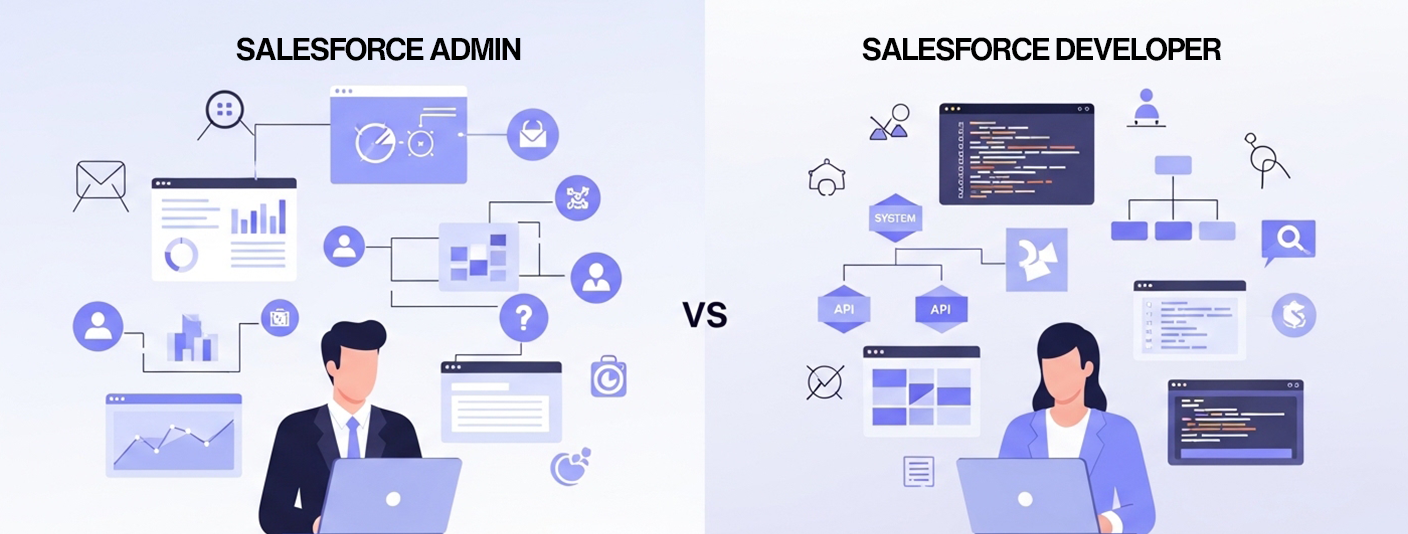
A Salesforce Administrator is the person who keeps the Salesforce platform running smoothly within a company. They don’t write code. Instead, they use Salesforce’s built-in tools, called “clicks, not code”, to manage users, set up workflows, build reports, and make sure the system fits the business’s needs.
Think of the Admin as the go-to person between the business team and the platform. When the sales manager says, “I need a new report,” or HR wants a new approval process, the Admin handles it, without ever opening a code editor.
What Does a Salesforce Admin Actually Do?
- Set up and manage user accounts, roles, and permissions
- Build reports and dashboards to track sales and business performance
- Automate processes using Salesforce Flow (no coding needed)
- Customize fields, page layouts, and objects to match business needs
- Train and support end users so they get the most out of Salesforce
- Manage data quality — imports, exports, deduplication
- Handle system updates, new feature rollouts, and troubleshooting
Skills a Salesforce Admin Needs
- Good understanding of business processes (sales, service, etc.)
- Comfort with Salesforce’s declarative tools: Flow, Process Builder, Validation Rules
- Strong communication skills — admins work closely with teams
- Basic knowledge of data management and security models
- Problem-solving mindset
Key Certifications for Admins
- Salesforce Certified Administrator (the starting point — recommended study time: 2–3 months)
- Salesforce Certified Advanced Administrator
- Platform App Builder
- CPQ Specialist
Who Is a Salesforce Developer?
A Salesforce Developer steps in when the standard platform tools aren’t enough. They write actual code to build custom functionality, things like complex integrations with third-party software, custom user interfaces, or automations that require heavy logic.
Developers need to know Apex (which is similar to Java), JavaScript, HTML, and how to work with APIs. They’re more technical by nature and typically work closely with admins to understand what the business needs before writing a single line of code.
A good way to think about it: if an Admin can solve 70–90% of business needs using the tools built into Salesforce, a Developer handles the remaining 10–30% that require custom code.
What Does a Salesforce Developer Actually Do?
- Write Apex code to create custom business logic
- Build Lightning Web Components (LWC) for custom interfaces
- Develop API integrations — connecting Salesforce with third-party tools
- Handle complex data operations and large-volume automation
- Create custom applications on the Salesforce platform
- Work on AppExchange products
- Collaborate with Admins on advanced solutions
Skills a Salesforce Developer Needs
- Programming knowledge — Apex, JavaScript, HTML
- Understanding of SOQL (Salesforce’s query language)
- Experience with REST/SOAP APIs
- Knowledge of Lightning Web Components (LWC)
- Understanding of governor limits and Salesforce architecture
- Debugging and testing skills
Key Certifications for Developers
- Salesforce Platform Developer I (entry-level — study time: 4–6 months)
- Salesforce Platform Developer II (advanced)
- JavaScript Developer I
- MuleSoft Developer (for integration work)
If You Curious to Know About Salesforce Consulting Services, Click here.
Salesforce Admin vs. Developer: Side-by-Side Comparison
Here’s a direct side-by-side comparison of both roles across the things that matter most:
| Category | Salesforce Admin | Salesforce Developer |
|---|---|---|
| Primary Focus | Managing & configuring the platform | Building custom features with code |
| Tools Used | Flow, Process Builder, Reports, App Builder | Apex, LWC, VS Code, APIs, SOQL |
| Coding Required | No (or minimal) | Yes — Apex, JavaScript, HTML |
| Entry Certification | Salesforce Certified Administrator | Platform Developer I |
| Time to Get Certified | 2–3 months | 4–6 months (varies by coding background) |
| Avg. US Salary (2025) | ~$100,000/year | ~$127,000/year |
| Best For | Business-minded problem solvers | Technical professionals who love to code |
| Works With | Sales, service, marketing teams | IT, architects, other developers |
| Job Growth (2025) | 14% global demand increase YoY | High demand at enterprise level |
Salary Comparison: What Do They Earn?
In the US, Salesforce Admins earn a median salary of around $100,000 per year, while Salesforce Developers average around $127,000 per year. Senior developers can earn $145,000 or more annually. Here is the simple breakdown of the salary in the following table;
| Experience | Admin Salary (US) | Developer Salary (US) |
|---|---|---|
| Entry Level | $68,000 – $90,000 | $90,000 – $105,000 |
| Mid Level | $90,000 – $103,000 | $105,000 – $127,000 |
| Senior Level | $103,000 – $130,000 | $127,000 – $145,000+ |
Keep in mind: an experienced Admin who adds technical skills, like mastering Salesforce Flow, AI tools, or Data Cloud, can close that gap significantly. Many experienced Admins earn as much as mid-level Developers.
The Salesforce Job Market in 2026
The Salesforce job market faced challenges in 2023 and 2024 due to tech layoffs and an oversupply of certified professionals. The market began stabilizing in 2025, and in 2026, it continues to show signs of recovery with a more competitive, employer-driven environment.
According to the latest 10K Salesforce Talent Ecosystem Report and industry analyses:
- Global talent demand rose by about 8% year-over-year, though supply grew even faster (around 27%), leading to continued saturation — especially at entry and junior levels.
- Entry-level Admin roles remain highly competitive, with basic configuration work increasingly automated by tools like Agentforce and Flow.
- Developer demand stays relatively strong at the enterprise level, particularly for professionals skilled in AI/Agentforce, Data Cloud, integrations (MuleSoft), and modern architecture.
The clear pattern in 2026: Generalists with broad, basic skills are finding it tougher to stand out. Specialists and those with focused expertise are landing opportunities faster.
If you’re entering the Salesforce ecosystem in 2026, choosing a niche makes a big difference — such as healthcare, financial services, Revenue Cloud, Agentforce/AI automation, or Data Cloud. Hybrid skills (low-code + some coding + AI governance) are becoming the new standard for both Admin and Developer roles.
Read More: Salesforce Agentforce Implementation Guide
Which Role Is Right for You?
It comes down to what kind of work you actually enjoy doing. Both are solid careers. Here’s a straight way to think about it:
Go Admin If You…
- Like solving business problems, not writing code
- Want to be job-ready faster (2–3 months)
- Enjoy working with sales and operations teams
- Want a smooth entry into the Salesforce world
- Are good at organizing processes and data
- Plan to move into consulting or architecture later
Go Developer If You…
- Love coding and building things from scratch
- Have some programming background already
- Want higher earning potential over the long run
- Enjoy working on complex technical challenges
- Want to build custom apps and integrations
- Are comfortable with tools like VS Code and Git
One path a lot of people take: start as an Admin, get comfortable with the platform, then pick up Apex and move into development. Many experienced Salesforce Developers started as Admins. It gives you a real advantage because you already understand how the business side works before you start writing code.
Can One Person Do Both?
In smaller companies, yes, and it is pretty common. A Salesforce Admin-Developer hybrid handles the day-to-day platform work and also writes some Apex code when the job needs it. As companies grow, these roles usually split. Bigger businesses tend to have dedicated Admin teams and separate Developer teams working side by side.
Titles like “Salesforce Technical Admin” or “Admin-Developer” exist for exactly this type of person. If you like both sides of the platform, mid-size companies are often the best fit, they tend to value flexibility over having two people in separate roles.
Need Help With Your Salesforce Setup?
Whether you’re implementing Salesforce for the first time or scaling an existing org, Innovadel Technologies has the expertise to help. From Commerce Cloud builds to custom Apex development and Salesforce consulting, we’ve done it for brands across multiple industries.
Talk to Innovadel Technologies
FAQs
What is L1, L2, L3, and L4 developer?
L1 and L2 are entry-level or junior developers who need guidance. L3 is mid-level, handling independent tasks. L4 is senior level, leading complex work, mentoring others, and making key technical decisions. These are standard software engineering experience levels, not Salesforce-specific.
Is Salesforce Admin a good career in 2026?
Yes, it is still a good career in 2026 if you upskill. Demand exists for Admins who combine configuration skills with AI tools (Agentforce), automation, and business knowledge. Entry-level is competitive, but experienced or AI-fluent Admins have strong opportunities and solid salaries.
Which is better, Salesforce Admin or Developer?
Neither is better — it depends on you. Choose Admin if you like business processes and faster entry with less coding. Choose Developer for higher pay and technical challenges. Many start as Admin then move to Developer or hybrid roles. Both are valuable in 2026.
Is Salesforce Admin still in demand?
Yes, Salesforce Admins are still in demand in 2026, especially those skilled in Flow, data governance, and AI tools. Entry-level roles face more competition, but companies need experienced Admins for automation and platform management. Over 150,000 companies use Salesforce globally.
Will AI replace Salesforce Admin jobs?
No, AI will not replace Salesforce Admin jobs. It automates repetitive tasks like basic reports and simple flows. Admins are evolving into AI guardians who design processes, ensure governance, and handle business needs. The role is changing and becoming more strategic, not disappearing.